When does a team actually need a fractional iOS CTO?
A fractional iOS CTO covers the gap when your app ships but nobody senior owns the iOS side, and the foundation starts to cost you.
Most teams hire a fractional iOS CTO at the point where the app ships fine but nobody senior owns the iOS side. Features keep landing, the demo works, and the question of whether the foundation underneath them is sound never gets asked. The people who could ask it are the same people writing the features, under the same deadline. So nobody does.
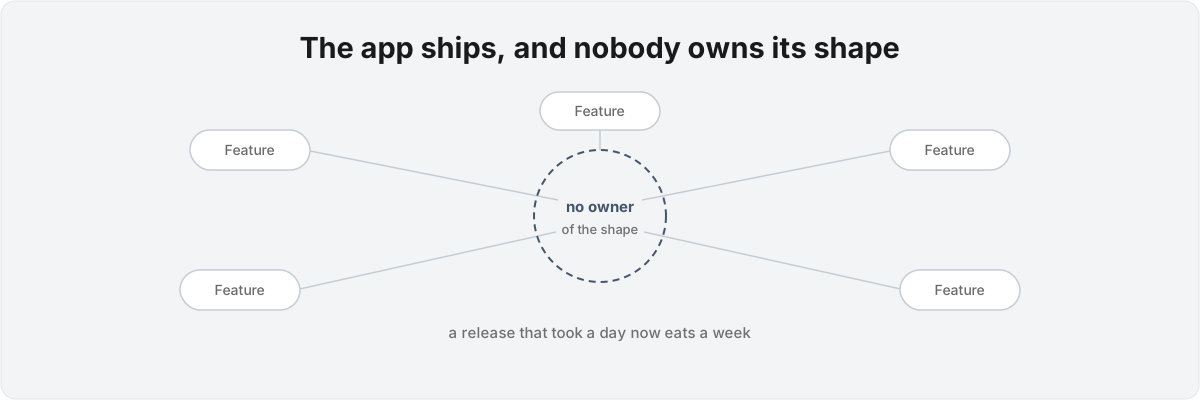
When do you need one? When the iOS work is moving but unowned. The app is in the store, releases are getting slower, and there is no single person whose job is the shape of the codebase rather than the next ticket. That is the gap a part-time iOS lead fills, and it almost never announces itself. It turns up later as a release that used to take a day and now eats most of a week, with nobody able to say when it got that way.
What does a fractional iOS CTO see that the team can't? 
The misleading thing about iOS is that an app built on weak architecture runs fine for a long time. A view controller that owns its own networking, parses the response, and writes to Core Data inline will pass review and keep users happy. It becomes a problem only when a second screen needs the same data, or when a new hire has to change it without reading the whole file first. By then the pattern is everywhere, copied into every screen that came after, and a decision that cost nothing at the start now costs a refactor to undo.
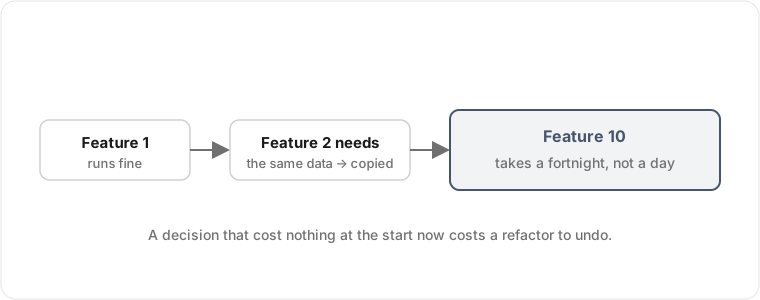
A team without a senior lead cannot see this from inside. A mid-level engineer ships what works and moves on, which is the right call under deadline pressure. Whether navigation runs off state or off imperative push calls, whether dependencies get injected so features can be tested in isolation, whether the concurrency holds up under Swift 6's strict checking[1]1. Swift 6 enables strict concurrency checking by default: data races that earlier compilers tolerated become compile-time errors, enforced through Sendable conformance and actor isolation. See Apple's Swift concurrency documentation and the Swift 6 migration guide.: none of these block the next feature, yet they decide whether the tenth one takes a day or a fortnight. Answering them is a different job from writing tickets, and on most small teams it is nobody's.
Bad architecture is slow because it removes the team's options. A screen that fetches, decodes, and persists inline cannot be reused, so the next screen copies it, and the copy diverges the day someone fixes a bug in one place and not the other. It surfaces as estimates that keep creeping, review that drags because every change has three plausible places to live, and a QA pass that finds the same class of bug every release. Reading those symptoms backward to the structural cause is the part the team cannot do while standing inside the code.
Is this just a senior contractor, or something different? 
It is a different job from contracting, and the difference is in what the work covers. A senior contractor takes tickets and ships them well; you get good code on the tasks you already knew you needed. A fractional iOS CTO works one level up, on the decisions that determine which tickets exist at all. The most expensive mistakes on an iOS team are rarely a bad function. They are a bad boundary drawn early, or an offline-sync model invented under deadline that every later feature routes around.
That last one is the canonical example of a decision that gets filed as an implementation detail when it is an architectural commitment. The moment your app holds state the user edits offline and reconciles with a server, you have built a distributed system whether or not anyone called it that. Conflict resolution, ordering, retries that are safe to run twice[2]2. A retry is safe to run twice when the operation is idempotent: applying it once and applying it many times leave the same result. Offline clients re-send requests after dropped connections, so a sync endpoint that is not idempotent can double-apply an edit. This is standard distributed-systems practice, not an iOS-specific rule.: these are design questions with right and wrong answers, and getting them wrong does not crash the app. It corrupts data slowly, in the field, on devices you cannot reach. I wrote about this class of edge case in you can't curl a border. A fractional lead earns the fee by having seen the failure mode before and naming it on a whiteboard, weeks before it reaches a user's data.
The same applies to the hiring call. Most small teams cannot tell from a one-hour interview whether the iOS engineer in front of them is genuinely senior or simply good at interviews, and getting that wrong on a four-person team points a quarter of your iOS capacity in the wrong direction for two releases before anyone notices.
Where do the costly iOS decisions actually live? 
They cluster in a handful of places, nearly all of them decisions you make once and live with for years. Architecture boundaries are the first: where state lives, what owns navigation, whether a feature is isolated enough to test on its own. Concurrency is the second, and since Swift 6 it has teeth: the compiler refuses to build code that races, so a codebase that was sloppy about actor isolation cannot simply be upgraded, it has to be reasoned about. The third is the dependency question every time you reach for a third-party SDK: what it costs in build time, in binary size, and on the day Apple changes a rule the SDK has not caught up with. The first two also decide most of what people later call a performance problem: a team sloppy about which work runs on the main actor finds out as a janky scroll on the hardware most of their users carry[3]3. To hold 60 frames per second a device has roughly 16 milliseconds to produce each frame, and about 8 milliseconds on a 120 Hz ProMotion display. UIKit and SwiftUI commit layout and rendering on the main thread, so blocking work scheduled there overruns the frame budget and drops frames, which the user reads as stutter during scrolling., and the fix is a boundary that belonged in the design.
I have shipped 12+ apps over more than ten years, several Featured by Apple, almost all on SwiftUI and The Composable Architecture. Metrics is one of them, with Apple's Foundation Models, App Intents, and WidgetKit in a single app, where the live decision was whether the on-device model work sat behind a clean boundary or leaked into every view: the first answer is cheap and the second one is a rewrite. That boundary had to be drawn before the views were written, because by the time the model code was spread across the app it would have been too late to put it back.
How does the engagement actually run? 
It runs on decisions far more than on commits. An ios technical advisor mostly works on the choices a team would otherwise make by accident: where the boundaries sit, what gets a test and what does not, which SDK is worth the dependency, whether the iOS hire you are about to make is genuinely senior. As an ios architecture consultant I do not write most of the code, and that is the point: a part-time lead who becomes a bottleneck in the commit history has recreated the single-point-of-failure the team was trying to escape. Code review from someone who has shipped to the App Store many times catches a bad pattern before it reaches ten screens and sets conventions the team then builds on. The cost it removes never shows up as a line item: the estimate creep nobody flags, and the rewrite that gets scheduled and then quietly cancelled because it grew too big to attempt.
App Store risk is the part that never shows up in code review or in tests. A rule you did not know about, a content guideline or a payments requirement or an age-rating bucket your app falls into by accident, surfaces instead as a rejection days before launch, or worse, a removal after it.[4]4. App Store Review Guidelines - objectionable content falls under Guideline 1.1, in-app purchase and payment requirements under Guideline 3.1.1, and age ratings are set through the App Store Connect age-rating questionnaire. These are the rules most often discovered at submission rather than during development. I have spent more time than I would like in the grey zones of App Review, both the content-rating logic with no real category for wellbeing apps and the reverse-engineering behind a PassKit pass Apple never published an API for, and knowing where those edges sit is part of owning the iOS side.
When is it too early, and when is it too late? 
It is too early when the question is still "what should we build" rather than "why is this getting harder to change", and too late when you are already paying for a full rewrite. The useful window is in between, while the app ships but the next big feature is still on the whiteboard. The same push-versus-state navigation call costs an hour before the feature exists and a fortnight after it is copied across the app.
The clearest signal that you have waited too long is a rewrite on the roadmap. A rewrite is what teams reach for when the codebase has accumulated so many local decisions that no one can hold its shape in their head, and it almost never works, because the second system inherits the same missing owner that produced the first. The cheaper intervention is to put someone senior on the shape of the existing code before the rewrite becomes the only option anyone can imagine, which is most of what a fractional iOS CTO is for.
If your iOS work is moving but nobody owns the shape of it, the time to talk is while the next big feature is still on the whiteboard. Tell me where it hurts, whether that is a slow release, a stalled rewrite, or a hire you are unsure about, and I will tell you whether it is an architecture problem, a process problem, or one you can fix without me.
Swift 6 enables strict concurrency checking by default: data races that earlier compilers tolerated become compile-time errors, enforced through
Sendableconformance and actor isolation. See Apple's Swift concurrency documentation and the Swift 6 migration guide. ↩︎A retry is safe to run twice when the operation is idempotent: applying it once and applying it many times leave the same result. Offline clients re-send requests after dropped connections, so a sync endpoint that is not idempotent can double-apply an edit. This is standard distributed-systems practice, not an iOS-specific rule. ↩︎
To hold 60 frames per second a device has roughly 16 milliseconds to produce each frame, and about 8 milliseconds on a 120 Hz ProMotion display. UIKit and SwiftUI commit layout and rendering on the main thread, so blocking work scheduled there overruns the frame budget and drops frames, which the user reads as stutter during scrolling. ↩︎
App Store Review Guidelines - objectionable content falls under Guideline 1.1, in-app purchase and payment requirements under Guideline 3.1.1, and age ratings are set through the App Store Connect age-rating questionnaire. These are the rules most often discovered at submission rather than during development. ↩︎